The Art of Healthy Skin Ageing
The Sole Revival Way
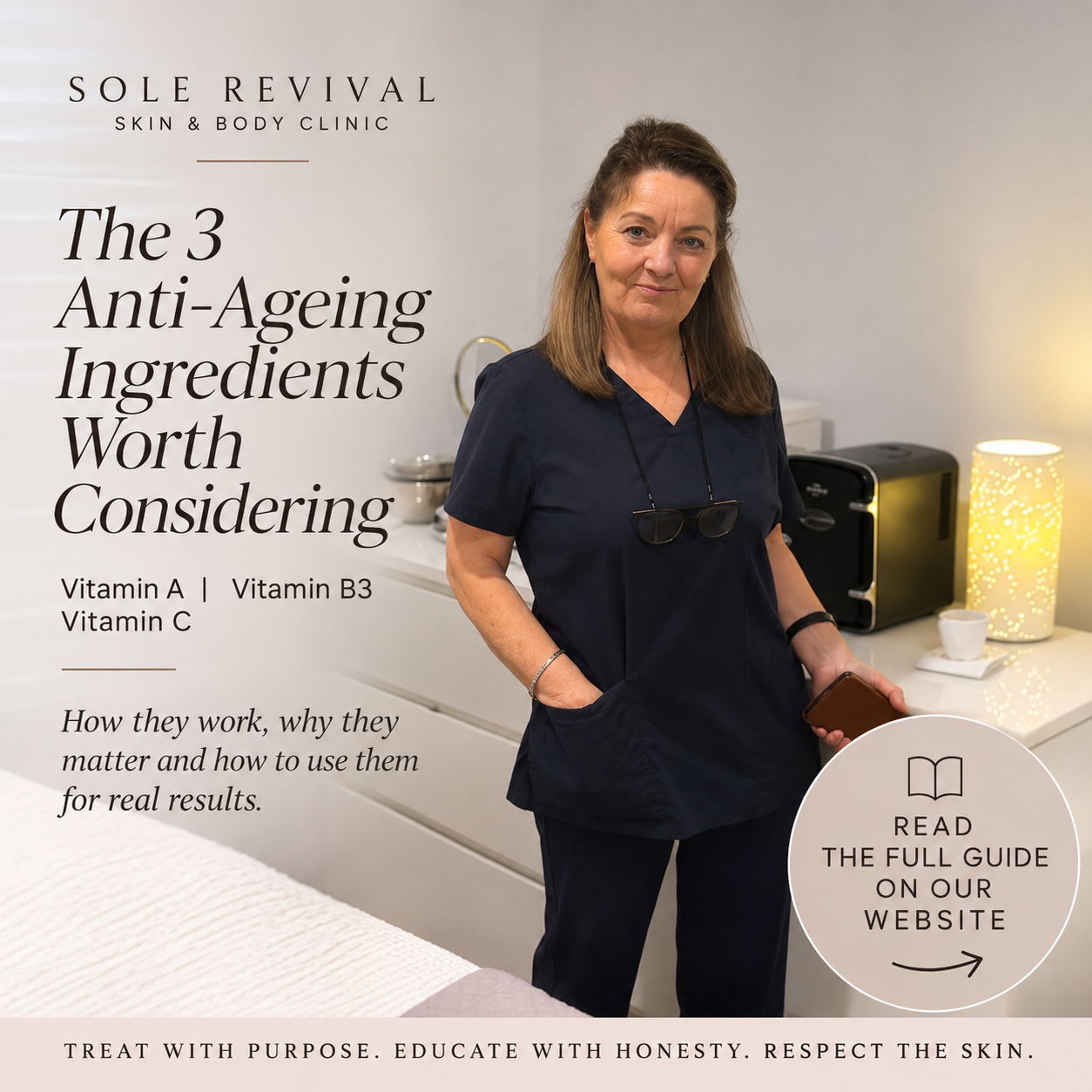
Healthy skin ageing isn’t about trying to turn back the clock. It’s about understanding how our skin changes, what it needs and how we can support its natural functions.
With so much conflicting information surrounding skincare and professional treatments, I want to share some of the science behind the ingredients and technologies I believe are worth investing in.
Three ingredients worth considering
REFINE — Vitamin A
Retinol and retinal help support skin cell renewal, collagen production and improvements in fine lines, uneven texture and pigmentation.
Retinal requires one fewer conversion step within the skin than retinol. However, concentration, formulation, stability and individual tolerance all influence effectiveness.
Introduce Vitamin A gradually, preferably in the evening. Topical retinoids should be avoided during pregnancy.
HYDRATE — Vitamin B3
Niacinamide is one of our most versatile skincare ingredients.
It supports ceramide production, strengthens the skin barrier, reduces moisture loss and helps improve the appearance of redness, uneven pigmentation and fine lines.
It is particularly worth considering as our skin undergoes hormonal and age-related changes.
FIRM — Vitamin C
Vitamin C is a powerful antioxidant that plays an essential role in collagen synthesis.
It helps protect against oxidative stress whilst improving the appearance of brightness, firmness and uneven skin tone.
However, Vitamin C can be challenging to stabilise within a formulation, which is why the quality of the formulation matters.
Not all serums are created equal
The percentage of an active ingredient tells us only part of the story.
Stability, pH, delivery systems, concentration and the ability of an ingredient to penetrate the skin all influence its effectiveness.
More is not necessarily better, and introducing too many active ingredients at once can compromise the skin barrier.
Your skincare routine should have a purpose. Every product should have a reason for being there.
Restore hydration and respect the skin barrier
As we age, particularly during and after menopause, our skin may become less effective at retaining moisture.
A well-formulated moisturiser should incorporate ingredients that attract moisture, replenish lipids and reduce water loss.
Look for ingredients such as glycerin, hyaluronic acid, ceramides, squalane and fatty acids.
Sometimes the most beneficial thing we can do for our skin is restore its barrier rather than introduce another corrective ingredient.
Sunscreen — separating science from misinformation
There is an increasing amount of conflicting information surrounding sunscreen.
However, decades of scientific research demonstrate that UV exposure is a major contributor to premature skin ageing, pigmentation, collagen degradation and skin cancer.
An Australian randomised controlled study found 24% less skin ageing in participants who used sunscreen daily over four and a half years compared with those who used it at their discretion.
The detection of certain sunscreen ingredients in the bloodstream does not, in itself, establish that they cause harm.
There is no convincing clinical evidence that correctly used, TGA-approved sunscreen increases cancer risk.
Apply a broad-spectrum SPF 50+ as the final step of your morning routine. Reapply every two hours when outdoors and after swimming, heavy perspiration or towel-drying.
Combine sunscreen with protective clothing, shade, sunglasses and a hat.
Four professional treatments worth considering
Professional skin treatments should complement your home skincare routine. Each technology works through different biological mechanisms, which is why treatment selection matters.
Dermapen4 Microneedling — Stimulate and Rem remodel
Microneedling creates controlled micro-injuries that initiate the body’s natural wound-healing response, encouraging collagen production and tissue remodelling.
It can improve the appearance of fine lines, uneven texture, enlarged pores and certain types of acne scarring.
The Dermapen4 incorporates 16 precision needles, delivering up to 1,920 microchannels per second, with digitally adjustable speed and depth.
However, advanced equipment is only part of the equation.
As a Master Skin Needler, I understand the importance of visually reading the skin, assessing its response and identifying the appropriate clinical endpoint.
Am I looking for erythema or pinpoint bleeding? What depth is appropriate for the concern I am treating?
Working solely with numbers can be misleading. Every skin is different, and greater depth does not necessarily mean better results.
Radiofrequency — Firm and Support
Non-invasive radiofrequency delivers controlled thermal energy into the tissues, encouraging collagen remodelling.
It can help improve the appearance of mild skin laxity, firmness, fine lines and facial contours.
It is particularly worth considering for changes around the lower face, jawline and neck.
Understanding temperature, energy delivery and tissue response is essential. Heating the skin excessively does not produce better results and can cause damage.
Laser — Target and Correct
Laser and light-based technologies allow us to target specific structures within the skin, including melanin and haemoglobin.
Depending on the technology and individual skin concern, these treatments can help improve the appearance of sun damage, benign pigmentation, superficial blood vessels, redness and uneven skin tone.
Not all pigmentation should be treated with laser. Some conditions, including melasma, can be aggravated by inappropriate treatment.
New, changing or suspicious pigmented lesions require medical assessment before cosmetic treatment.
Understanding wavelengths, skin phototypes and tissue responses is fundamental to responsible practice.
Diamond Microdermabrasion — Refine and Renew
Diamond microdermabrasion is a treatment I believe is often underestimated.
It combines controlled mechanical exfoliation with suction to improve skin texture, superficial congestion and radiance.
Mechanical stimulation can encourage local microcirculation, whilst the movement of the handpiece may assist superficial fluid movement.
Through a process known as mechanotransduction, skin cells respond to mechanical stimulation by activating biological signalling pathways associated with renewal and repair.
From my own clinical experience, I prefer diamond microdermabrasion to crystal-based systems because of the control it offers me as a practitioner.
A treatment can feel remarkably gentle whilst still delivering effective exfoliation.
We do not need to traumatise the skin to encourage renewal.
Knowledge makes the difference
One of the most important qualities a practitioner can possess is the ability to recognise not only what someone’s skin needs, but also what it doesn’t need.
Sometimes the skin requires stimulation. Sometimes it requires restoration. Sometimes it simply needs to be left alone.
Knowing the difference is where education, experience and clinical judgement come together.
Healthy skin. Natural ageing. A more considered approach to beauty.
TREAT WITH PURPOSE. EDUCATE WITH HONESTY. RESPECT THE SKIN.
And never forget the person standing in front of you.
Jules O’Driscoll
BA Hons Complementary Healthcare
Master Skin Needler
Accredited Laser Technician
WASSABA 2026 Spa Therapist of the Year
Sole Revival Skin & Body Clinic
Winthrop, Perth, Western Australia
Further reading:
Hughes et al. Sunscreen and Prevention of Skin Aging: A Randomized Trial. Annals of Internal Medicine, 2013.
Cancer Council Australia — Sunscreen safety and sun protection recommendations.
Karimipour et al. Molecular Analysis of Aggressive Microdermabrasion in Photoaged Skin. Archives of Dermatology, 2009.