Healthy Skin Before Corrective Treatments
What the latest skin science is teaching us
One of the things I love about working in skin therapy is that there is always something new to learn.
Every week, I make time to explore scientific research, not simply to discover the next big thing in skincare, but to question what we already do, why we do it and whether the evidence supports it.
This week, I have been exploring skin barrier health, microneedling, skin ageing and the emerging science behind regenerative skincare.
Interestingly, much of the research reinforces the principles I already work with at Sole Revival.
Does your skin really need more?
We live in a world where we are constantly encouraged to add another serum, introduce a stronger active ingredient or invest in the latest treatment.
But what if your skin actually needs less?
Our skin barrier is a remarkably complex protective system. When compromised, the skin can become dehydrated, sensitive, irritated and more reactive.
Sometimes, the most beneficial approach is to simplify your skincare routine, support hydration and allow the skin time to recover before introducing corrective treatments.
Knowing when to treat and when to restore is equally important.
Microneedling – it’s not just about the needles
Research continues to explore how microneedling influences the delivery of substances into the skin.
What interests me is the importance of needle depth, product formulation and application technique.
Creating microchannels in the skin does not mean that every skincare ingredient should be introduced through them. Nor does increased penetration automatically translate into better results.
This is where practitioner education, appropriate product selection and an understanding of skin physiology really matter.
Does a stronger treatment mean better results?
Not necessarily.
Microneedling and microdermabrasion stimulate the skin in different ways, and understanding these differences helps us select the most appropriate treatment.
The objective is not to see how much stimulation the skin can tolerate, but to encourage an appropriate biological response while respecting its ability to recover.
And what about exosomes?
There is considerable excitement surrounding exosomes and regenerative skincare, and it is an area of research I am following closely.
Whilst early findings are interesting, larger studies and longer follow-up periods are needed before we can confidently make claims about long-term benefits.
Promising science and proven clinical outcomes are not the same thing.
Why does all of this matter to you?
Because when you visit Sole Revival, I want you to feel confident that the treatments I recommend are considered, purposeful and informed by science rather than industry trends.
Ongoing education is not an optional extra for me. It is part of my professional responsibility to you and your skin.
Healthy skin. Natural ageing. A more considered approach to beauty.
TREAT WITH PURPOSE.
EDUCATE WITH HONESTY.
RESPECT THE SKIN.
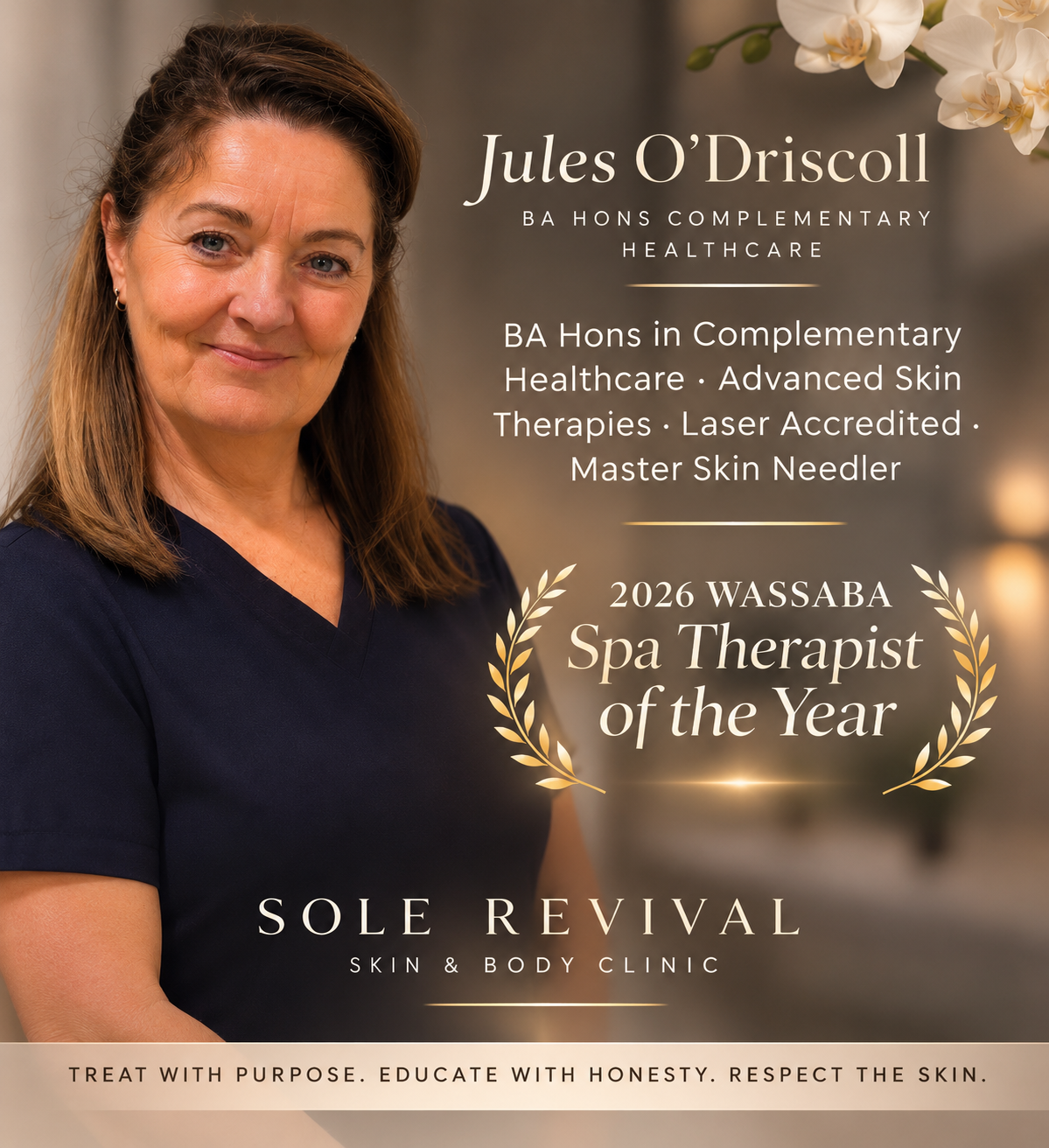
Jules O’Driscoll
BA Hons Complementary Healthcare
Sole Revival Skin & Body Clinic
Further reading
For those who enjoy exploring the science behind their treatments, here are the research links from this week’s reading:
● Skin barrier health and restoration
● Microneedling and enhanced product delivery
● Mechanically induced skin renewal
● Emerging research into regenerative skincare